Showing 1–12 of 75 results
The Modern Standard
Feminised Cannabis Seeds
Feminised seeds are the modern standard for the vast majority of home growers and commercial cultivators. Because breeders use specialized techniques to cross two female plants, there are no male chromosomes (Y) in the genetic mix. The result? Seeds that produce bud-bearing female plants 99.9% of the time.
The Sweet Spot of Cultivation
They hit the sweet spot between the guaranteed harvest of autoflowers and the massive yield potential of regular seeds. Because they are “photoperiod” plants, you are in total control.
99.9% Female
No wasting resources on male plants. Every seed you plant is almost guaranteed to produce dense, smokable flowers.
Photoperiod Control
You dictate exactly how big they get during the vegetative phase by keeping lights on for 18+ hours.
On-Demand Flowering
You decide exactly when they start making buds by switching to 12 hours of dark, allowing for massive yield potential.
Top 10 Mistakes When Growing Feminised Seeds
Because you are the one pulling the strings on their environment, the biggest mistakes with feminised seeds usually come down to grower error regarding light, space, and timing.
Light Leaks During Flowering
Once you switch to a 12/12 light cycle to trigger flowering, the plant requires uninterrupted, pitch-black darkness for those 12 hours.
Having a pinhole leak in your grow tent, a glowing power strip inside, or opening the zipper to “take a quick peek” during the dark period.
Tape over all LED lights on equipment. If you can see your hand in front of your face with the lights off, you have a leak. Fix it, or the plant may stress out and grow male pollen sacs.
Underestimating “The Stretch”
When you flip the lights to 12/12, it enters a transition phase where it rapidly shoots upward to get as close to the light source as possible.
Letting the plant fill your grow tent entirely during the vegetative phase before flipping the lights.
Expect your plant to double, or even triple, in size. If your tent is 6 feet tall, flip the lights when the plant is roughly 2 feet tall to leave room for the stretch.
Neglecting to Train Them
Because you have unlimited vegetative time, letting a feminised plant grow straight up like a Christmas tree is a massive waste of potential.
Only allowing the main top cola to get direct light, resulting in “popcorn buds” (tiny, underdeveloped flowers) on the lower branches.
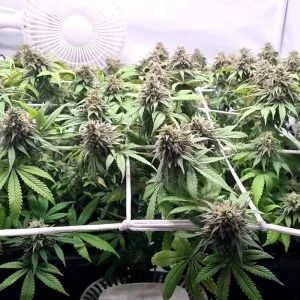
Use techniques like Topping and the Screen of Green (SCROG) method to create a flat, even canopy where every bud gets intense, direct light.
Over-Defoliating
Growers often see photos of manicured plants on Instagram and assume they need to cut off all the large fan leaves.
Stripping the plant naked. Fan leaves are the plant’s solar panels; they generate the energy needed to grow massive buds.
Only remove leaves that are completely blocking lower bud sites, or strip the bottom 1/3 of the plant (which gets no light anyway). Leave the top canopy intact.
Forgetting They Aren’t Autos
This happens frequently to growers transitioning from autoflowers to feminised seeds.
Leaving the lights on 18/6 for three months and wondering why the plant is massive but hasn’t produced a single bud.
The plant will wait for you forever. You must physically change the timer to 12 hours of light and 12 hours of dark to force it to flower.
Flipping a Sick Plant
Since you control the timeline, there is no excuse to send a struggling plant into the stressful flowering stage.
Flipping the lights to 12/12 while the plant has a nutrient deficiency, pest problem, or severe droop from overwatering.
Flowering locks in the plant’s structural fate. Keep lights on 18/6 for an extra week, nurse it back to perfect health, and then flip the lights.
The Nitrogen Trap
During veg, plants need Nitrogen. During flowering, they need Phosphorus and Potassium to build dense buds.
Switching entirely to “bloom” nutrients the exact day you flip the lights, or feeding high-Nitrogen “veg” nutrients deep into week 4 of flowering.
Taper your nutrients. Continue feeding veg nutrients during the first 2 weeks of the flip (to support the stretch), then slowly transition to bloom nutrients.
Transplanting During Flower
Repotting a plant causes root shock. During the vegetative stage, the plant has time to heal.
Realizing the plant is rootbound in week 3 of flowering and trying to move it to a larger pot.
Do all your transplanting at least one to two weeks before you flip the lights. Once it is making buds, its roots are essentially done expanding.
Ignoring Late-Stage Humidity
Because feminised seeds can be grown into massive plants with incredibly thick, dense colas, they are highly susceptible to Botrytis (bud rot).
Keeping humidity at 60%+ during final weeks. Moisture gets trapped inside dense buds, rotting them from the inside out.
Drop your relative humidity (RH) to 40-45% during the last 4 weeks of flower, and ensure strong oscillating fans blow air under and over the canopy.
Trusting the Calendar
Seed banks often market strains as having an “8-week flowering time.”
Chopping the plant down exactly 56 days after you flipped the lights, resulting in a weak, anxious high and lower yields.
The timeline is an estimate. Look at the trichomes under a loupe. Wait until they transition from clear, to cloudy/milky, with a few amber heads mixed in.